Support us

2018 – Our Place in Space. Astronomy and Art in Dialogue
.
.
to
.
.
Save to calendar
Button Text
2018 – Our Place in Space. Astronomy and Art in Dialogue
How and where do we perceive ourselves in the universe? Hubble images in dialogue with contemporary art at the Natural History Museum Vienna, 2018.
1:00
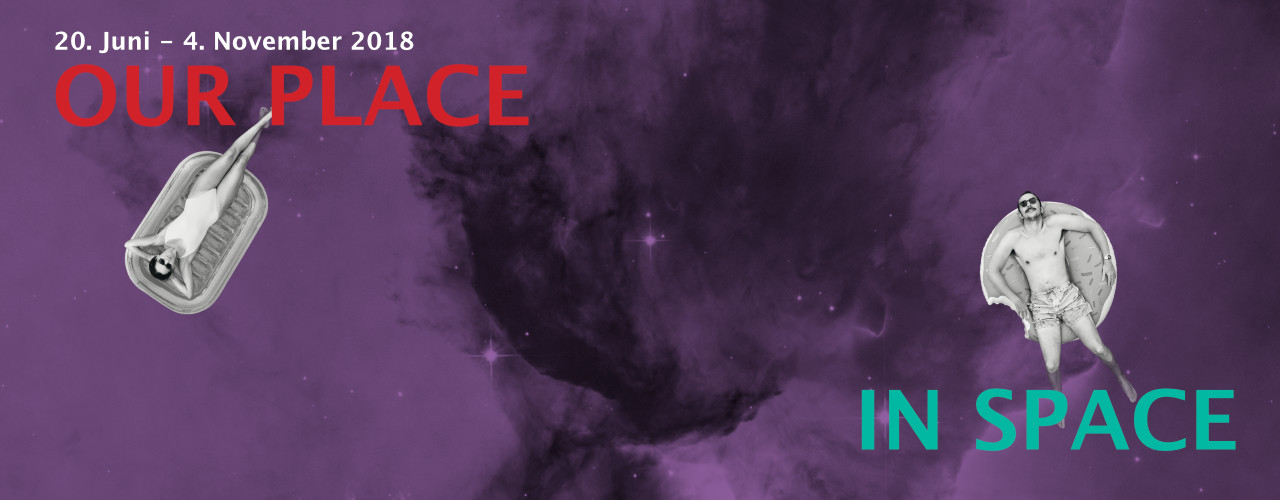
“Our Place in Space. Astronomy and Art in Dialogue”
… explores the question of how and where we perceive ourselves in the universe and what the future should bring. What do we believe we are capable of? We ask these questions in the sciences, in the arts and in politics – but they are also philosophical and personal questions.
The starting point of the special exhibition Our Place in Space is images from the Hubble Space Telescope, which was celebrating its 28th anniversary. For this, a travelling exhibition was conceived by Antonella Nota (ESA) and Anna Caterina Bellati (Bellati Editori), first shown in Venice in February 2017. Works by contemporary artists from each host country continually give the travelling exhibition a new profile.
Astronomy and Art in Dialogue
The exhibition at the Natural History Museum Vienna, curated by astronomer and artist Ulrike Kuchner, shows parts of this travelling exhibition in the context of artists working in Austria. What makes the selection special is that it invites not only the renowned artists Steinbrener/Dempf & Huber, Nives Widauer, Payer Gabriel, Markus Reisinger and Yunchul Kim, but also, through an open call at the University of Applied Arts, works by five young, ambitious artists from the Art & Science class led by Prof. Virgil Widrich. Margit Busch & Solmaz Farhang, Anna Lerchbaumer & Eleni Boutsika-Palles, Michael Bachhofer, Daniela Brill Estrada and Monica LoCascio refer to scientific images from the Hubble Space Telescope and open up new spaces and approaches for viewers.
What happens to our artistic work and our self-image when we realise that our home in the universe, the Milky Way, is just one speck copied millions of times among a sextillion specks? Every week we discover new Earths. But what makes our Earth unique? What makes other Earths unique? Where do we place ourselves in the solar system, in the Milky Way, in the universe – and where does the urge to explore come from? And how is the experience of observing, creating and exploring co-produced? The exhibition attempts to approach these questions through artistic works.
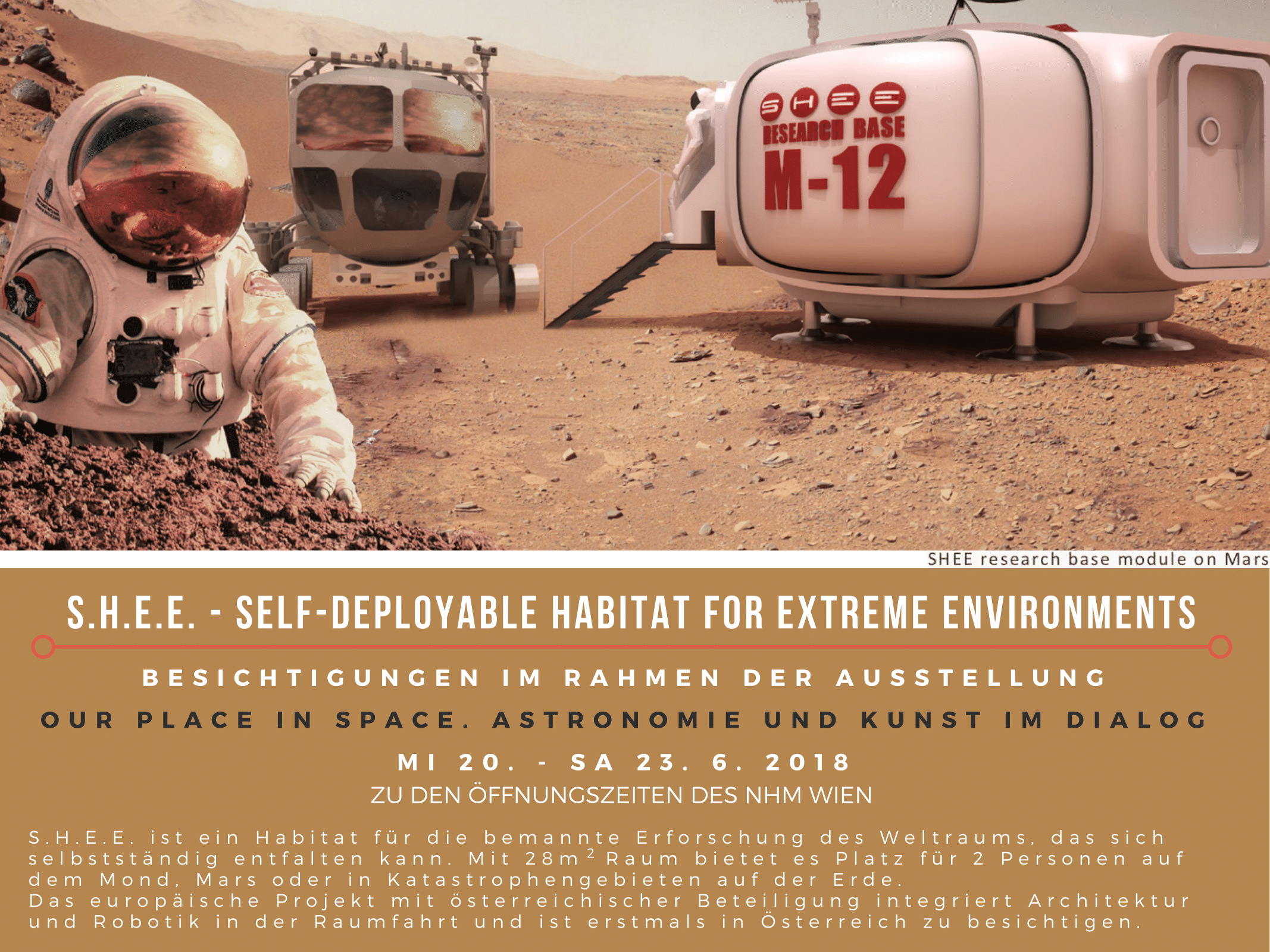
“S.H.E.E.” space habitat
With the first presentation in Austria of the “S.H.E.E.” space habitat, the exhibition offers a further highlight in its first week. The habitat is a self-deploying living space for people on the Moon, on Mars or in disaster areas on Earth, and can be visited in front of the NHM Vienna on Maria-Theresien-Platz from 20 to 23 June 2018.
We invite you on a journey that takes you out of Vienna towards outer space and ends at the edge of the observable universe. With this exhibition, we want to encourage people of all ages to join the interdisciplinary discourse between the two worlds of astronomy and art.
The exhibition is a cooperation between the Natural History Museum Vienna, the think tank GLOBART, the University of Applied Arts Vienna and the European Space Agency ESA.
From 20 to 31 August 2018, Vienna also hosts the General Assembly of the International Astronomical Union, with 4,000 guests expected – the world's most important meeting of internationally active astronomers.

Next stop of the travelling exhibition
14 November – 20 December
The gallery of the Centro Comercial Atlantis Plaza
Bogotá
Escape into Space
with Katrien Kolenberg, Björn Dahlem, René Wacvlavicek
Moderated by Friedrich von Borries
Changing perspectives: science on art / art on science
with Antonella Nota, Aoife van Linden Tol, Victoria Vesna, Luca Fossati, Anna Lerchbaumer, Daniela Brill Estrada, Eleni Boutsika-Palles, Vera Tollmann
Moderated by Klaus Speidel
S.H.E.E. Self-Deployable Habitat for Extreme Environments
- Flyer:
- Guided tours: 20–23 June 2018
during NHM opening hours
- Info: S.H.E.E. is a self-deploying building for human space exploration. With 28 m², it accommodates 2 people on the Moon, on Mars or in disaster areas on Earth. The European project with Austrian participation integrates robotics and architecture in space travel and can be seen in Austria for the first time.
Programme
No items found.
In partnership with:
No items found.
Funders:
No items found.
In cooperation with:
No items found.
Sponsors
No items found.
Collaborations
No items found.
Sponsors of the scholarship programme
No items found.
Media partners
No items found.
Become a member now or give a membership as a gift
Globart members benefit from the Globart network and from reduced participation fees at all events.