Support us

2019 FUTURZWEI – Harald Welzer & Dana Giesecke: “IN ZUKUNFT. Möglichkeitsräume”
.
.
to
.
.
Save to calendar
Button Text
2019 FUTURZWEI – Harald Welzer & Dana Giesecke: “IN ZUKUNFT. Möglichkeitsräume”
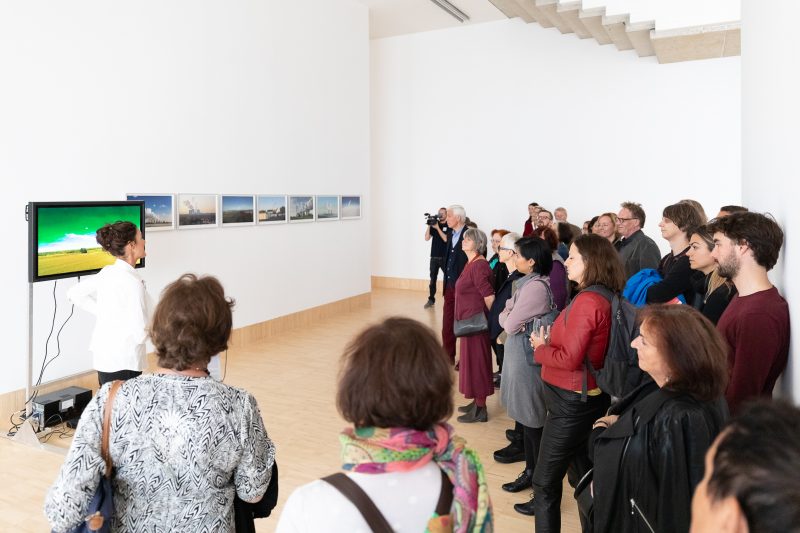
How do we imagine the future? The exhibition “IN ZUKUNFT. Möglichkeitsräume”, curated by Harald Welzer and Dana Giesecke, accompanied the GLOBART Academy 2019 at the Essl Museum in Klosterneuburg.
1:00
EXHIBITION “IN ZUKUNFT. Möglichkeitsräume” (In the Future. Spaces of Possibility)
In cooperation with FUTURZWEI. Stiftung Zukunftsfähigkeit
Curated by Harald Welzer and Dana Giesecke | 3–19 October 2019
with works by Karin Sander, Friedrich von Borries, Tim and Jan Edler,
Christoph Mayer chm, Regina Schmeken and others
–
How do we imagine the future?
This question accompanied the GLOBART Academy every single day. The exhibition “In Zukunft. Möglichkeitsräume”, curated by Harald Welzer, director of Futurzwei. Stiftung Zukunftsfähigkeit, and Dana Giesecke, both poses and confronts this question. It is based on a Futurzwei project: in “Zukunftsbilder der Nachhaltigkeit” (Images of a Sustainable Future), Harald Welzer's foundation asked various groups of young people in the German-speaking world about their dreams and visions of the future. Those who still have most of their future ahead of them were asked how they imagine a successful future – a counterpoint, so to speak, to negative forecasts and doomsday scenarios.
Christoph Mayer chm, realities:united, Karin Sander, Regina Schmeken and others visualised these imagined futures in artistic positions.
GLOBART invited Futurzwei to present parts of the exhibition during the GLOBART Academy at the Essl Museum in Klosterneuburg.
Together with Harald Welzer and Dana Giesecke, and in the presence of artists Karin Sander and Christoph Mayer chm, the exhibition opened on 5 October, the first weekend of the GLOBART Academy 2019, and accompanied us until the end of the Academy on 19 October 2019.
Children paint images of the future
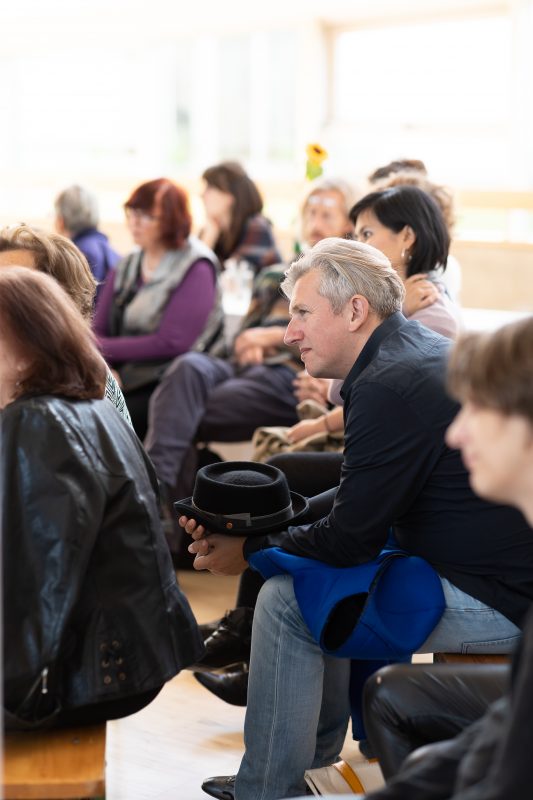
The diverse images of the future in the rooms of the Essl Museum encouraged us as visitors to question our own ideas of the future, and we invited school classes from Klosterneuburg and Vienna to open themselves up to the question. Various classes from the neighbouring Bundesgymnasium and Bundesrealgymnasium Klosterneuburg took part in the workshops every day. They were joined by a class from the newly opened Privatgymnasium Klosterneuburg, the KreaMontschule St. Andrä-Wördern and two classes from the Ella Lingens Gymnasium in Vienna.
The breadth of the topic made it possible to invite children and young people of different age groups. A total of 800 children and young people visited the Essl Museum from Monday to Friday between 3 and 19 October – a tremendous response to this important topic. In preparation for the exhibition, we first asked all students the same question: How do I imagine the future? How do I want to live in the future?
Students' statements on the question
“What do I wish for my future?”:
“I want to order less from Amazon.”
“I want to live in a world where animals aren't threatened with extinction because we fly so much.”
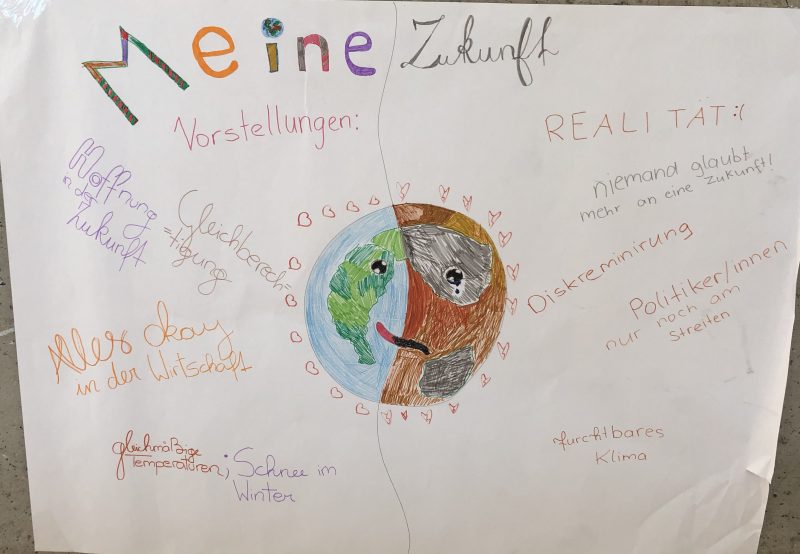
The very different answers were recorded in pictures and writing on posters. While most of the 10- to 12-year-olds raised environmental and climate protection of their own accord as a fundamental necessity for any thinking about the future, most of the 15- to 17-year-olds answered only in terms of their own surroundings and personal wellbeing. Many of the younger groups, for example, painted their ideas of a future planet Earth in two versions: as they would like it to be, and as it would look if nothing were done about the current climate crisis. Meanwhile, the drawings of the older students were dominated by status symbols such as cars, clothes, the latest iPhone and a general desire for wealth.
A training room for critique
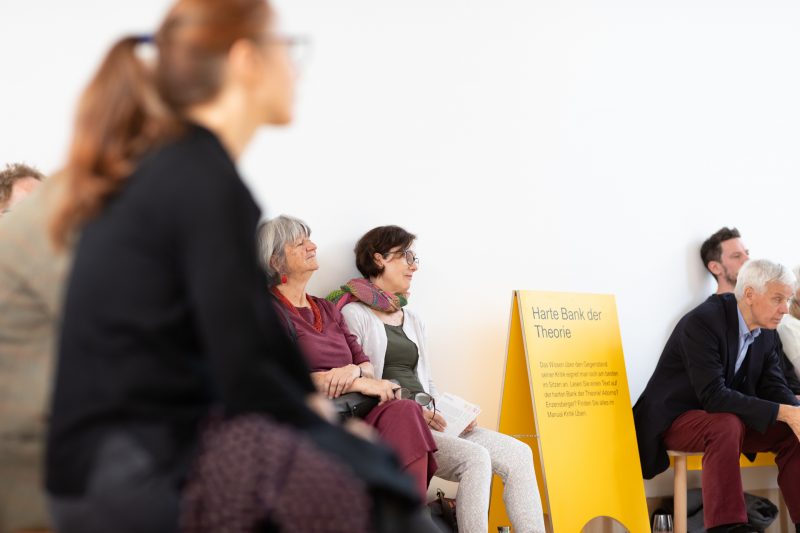
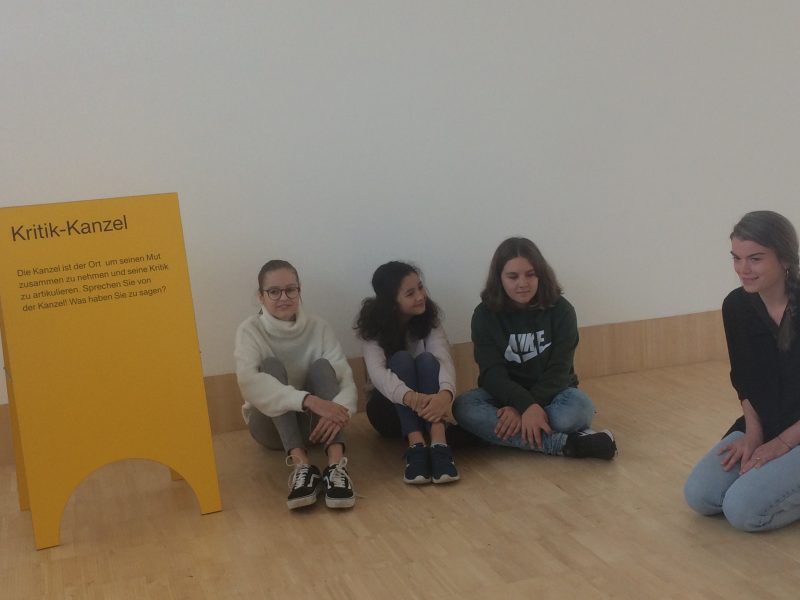
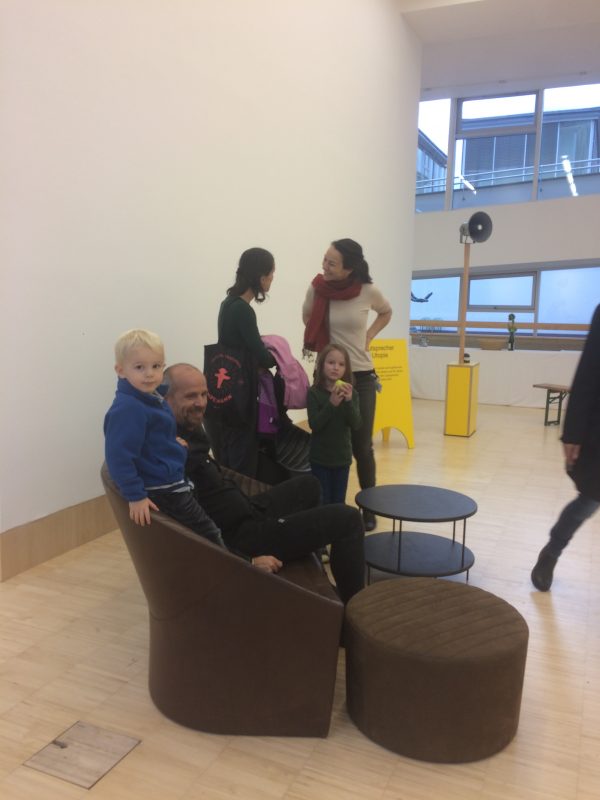
The “Training Room for Critique” (curated by Friedrich von Borries and Jakob Schrenk) was probably the most appealing part of our work with the children. Its various stations invited visitors, for example, to adopt a critical (body) posture, to formulate critique together, to take a seat on the argument swing, to stand before the mirror of self-knowledge or to step up to the pulpit of critique. Designed by Frieder Bohaumilitzky and students of the HFBK Hamburg, the devices were intended to help people relearn and practise social critique. With the idea that social change must begin with a critical look at one's own behaviour and with formulating wishes for one's own actions, we invited the students to stand in front of the mirror of self-knowledge.
Facing oneself in the mirror, observing one's own actions and reflecting on them in light of one's wishes for the future was difficult for many students. It is easy to feel embarrassed, distracted or unwilling.
But it was wonderful to see how younger girls in particular found the courage to engage. Voicing one's own wish for change aloud to the group from the pulpit of critique required just as much courage and sometimes produced exciting thoughts and results, but also met with rejection and reluctance. “What's the point?” and “Why should we do this?” were two questions put to us. It was often hard, too, to stay with oneself: to first ask “What can I change?” before asking “What do others have to change?”.
On the other hand, it was a rich experience to hear how much thought children and young people give to sustainability and environmental protection – a development that has surely been spurred on by Fridays for Future. In the discussion circle, many of the younger students told us how they pay attention to the environment at home: reducing plastic packaging, shopping at zero-waste stores, recycling, cycling and scooting, even a holiday collecting plastic on the beach. Topics such as the clothing industry and shopping habits, social inequality, poverty and gender discrimination, on the other hand, were hardly mentioned.
Students' statements at the pulpit of critique:
“I mainly pay attention to myself, to how I look and what clothes I buy, not to what that means for the environment.”
“In the future I want to be more a part of the class community and go to climate demos together.”
“I want to study new technologies to help shape progress.”
“I want to use fewer plastic bags.”
“I want to fly less.”
“I want to criticise myself less as a person and learn to love myself instead.”
The future as an empty space
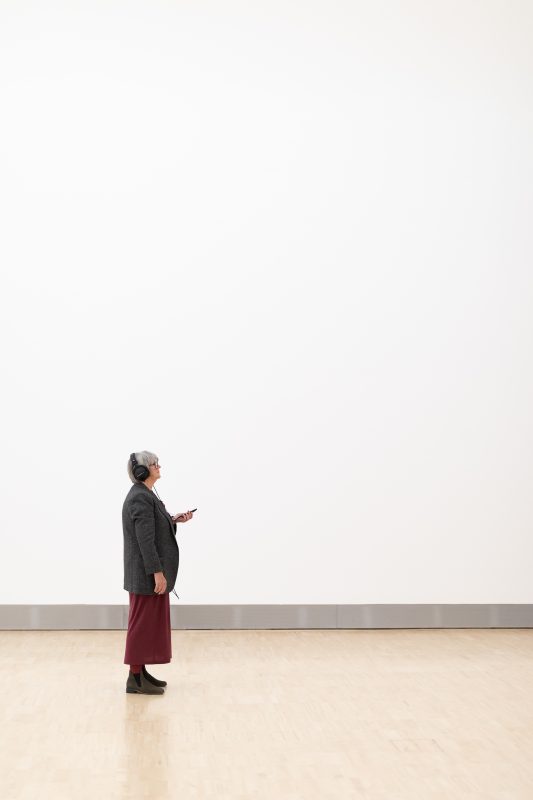
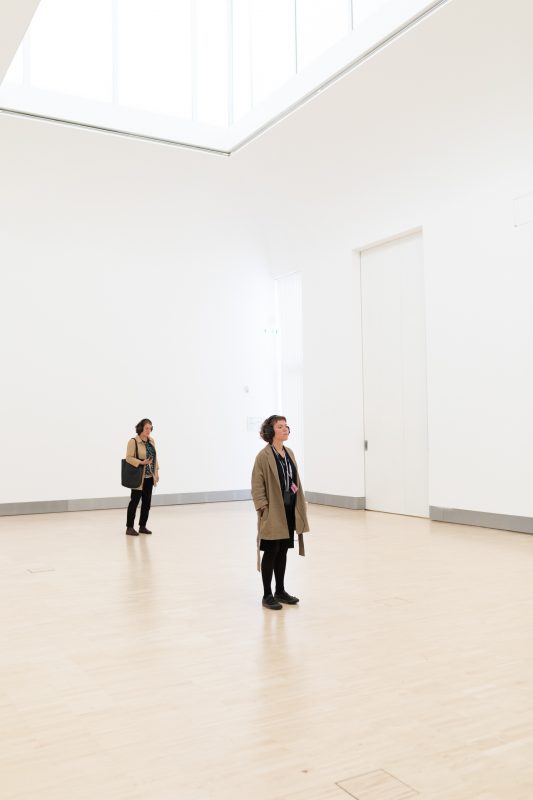
We invited some students who were open to the experience to step into Christoph Mayer's soundtrack, created in collaboration with Andreas Hagelüken. The project was very well received by many visitors during the Academy. Building on the study “Zukunftsbilder der Nachhaltigkeit”, Christoph Mayer chm conducted in-depth interviews with the participants and experienced how hard it is for young people to formulate goals for the future. In “Audio Path into a Space for Action”, he has visitors walk through an empty room while listening to the young people's recorded reflections. Those who embarked on the journey could experience the future as both an inner and an outer space – a space to be entered step by step, a space with doors and breadth, a space in which much is open and in which we sometimes hold ourselves back from moving on.
The exhibition “In Zukunft. Möglichkeitsräume” was one of the most enriching projects of the GLOBART Academy 2019. It showed us dystopian and post-catastrophic visions of the future, invited us to pause and exchange ideas, confronted us with important questions and let us pass them on – and it showed us which tasks we must work on together.
Programme
No items found.
In partnership with:
No items found.
Funders:
No items found.
In cooperation with:
No items found.
Sponsors
No items found.
Collaborations
No items found.
Sponsors of the scholarship programme
No items found.
Media partners
No items found.
Become a member now or give a membership as a gift
Globart members benefit from the Globart network and from reduced participation fees at all events.